Your Career Fair Generated Zero Hires: 5 AI Assessment Secrets That Turn Campus Visits Into Job Offers in 30 Days
- Monish Kumar

- Feb 24
- 5 min read
Let me guess: you spent thousands on that career fair. The booth was perfect. Your recruiters were there with smiles and swag. You collected 200+ resumes.
And after all that? Zero hires.
Maybe one mediocre intern who ghosted you after three weeks.
Here's the brutal truth: your campus recruiting strategy is stuck in 1995 while the talent war is happening in 2026. You're still playing the résumé game when everyone else is using AI-powered assessments that actually predict job performance.
The good news? You're about to discover five AI assessment secrets that turn campus visits from expensive photo ops into hire-generating machines: in 30 days or less.
Why Your Career Fair Strategy Is Hemorrhaging Money
Traditional campus recruiting follows the same broken playbook:
Show up with branded pens and pizza
Collect a mountain of résumés
Have HR sort through them manually
Schedule interviews weeks later
Watch 80% of candidates accept other offers while you're still "reviewing applications"
This isn't recruiting. It's theater.
The average cost per campus hire is $50,000 when you factor in recruiter time, travel, lost productivity, and the opportunity cost of positions sitting empty for months. And most companies are getting a return on investment that's laughable.
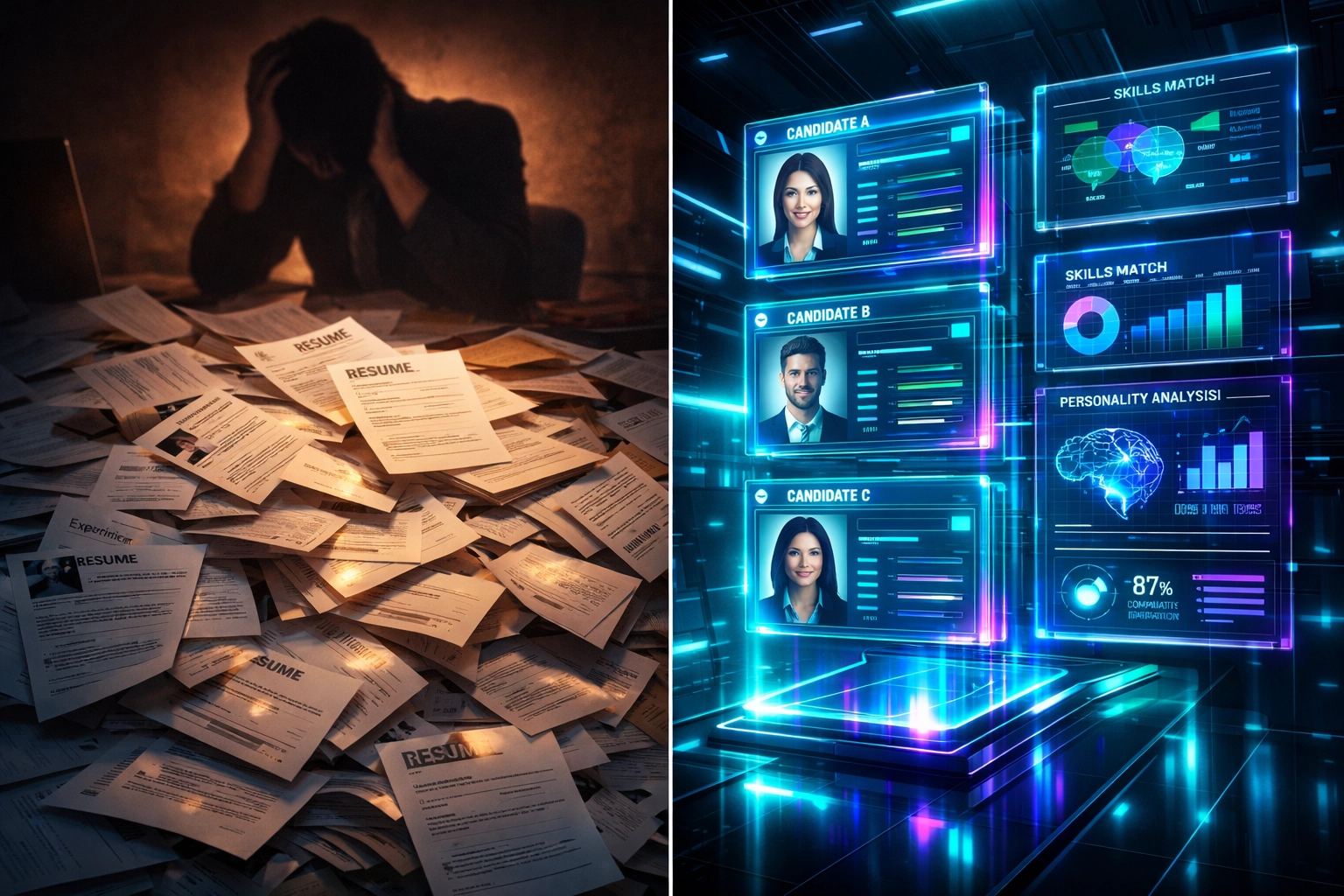
Meanwhile, companies using intelligent automation solutions for campus recruiting are filling positions in 30 days with candidates who actually stick around and perform.
The difference? They're not guessing based on GPA and a firm handshake. They're using AI assessments that measure what actually matters.
Secret #1: Replace Résumé Screening with Behavioral AI Analysis
Stop pretending that a piece of paper tells you anything meaningful about job performance.
AI-driven video assessments evaluate observable behaviors: reasoning patterns, communication clarity, problem-solving approaches, and motivation indicators. Not whether someone went to an Ivy League school or had a 4.0 GPA.
Here's what actually happens when you implement behavioral AI analysis:
In a trial with 37,000+ applicants for junior developer roles, candidates who advanced through an AI-assisted pipeline were 20 percentage points more likely to succeed in subsequent blind human interviews than those selected by traditional résumé screening. The gains were especially strong for early-career applicants: exactly the talent pool you're mining at career fairs.
You know what that means? You're currently throwing away your best candidates because their résumé didn't scream "prestigious internship at Fortune 500 company."
How to implement this:
Deploy AI assessments immediately after career fair interactions
Use NLP solutions to analyze candidate communication patterns and technical articulation
Score candidates on job-relevant competencies, not credentials
Prioritize candidates with high behavioral scores regardless of pedigree
This isn't about replacing human judgment: it's about giving your recruiters actual data instead of gut feelings based on where someone went to school.
Secret #2: Real-Time Screening That Turns Weeks Into Hours
Remember those 200 résumés you collected? By the time your team "gets around to reviewing them," your top candidates have already accepted three other offers.
Speed kills in campus recruiting. The company that can assess, interview, and extend an offer fastest wins.
AI-powered real-time screening changes the entire timeline:
Candidates complete assessments within 24 hours of the career fair
AI phone screening agents conduct initial conversations immediately
Automated scoring identifies top performers instantly
Your recruiters focus only on high-potential candidates
Instead of waiting 3-6 weeks for a response, students hear back in 48 hours. You're not just faster: you're the only company that treated them like they actually matter.
Companies using custom AI solutions for real-time candidate engagement report 65% faster time-to-hire and dramatically higher offer acceptance rates. Because when you respect someone's time, they remember.

Secret #3: Skill-Based Evaluation That Finds Hidden Gems
Here's a dirty secret about campus recruiting: traditional methods systematically overlook incredible talent.
Why? Because résumé-based screening favors candidates who know how to "play the game": fancy internships, connections, the right keywords. It penalizes students who spent college years working to pay tuition, taking care of family, or building actual skills instead of networking.
AI assessments don't care about any of that theater.
They evaluate what candidates can actually do:
Can they solve problems under pressure?
Do they communicate technical concepts clearly?
How do they approach unfamiliar challenges?
What's their learning velocity?
These are the predictors of job performance. Not whether they had an uncle who got them a summer internship.
Implementation strategy:
Create skill-based challenges aligned with actual job responsibilities
Use AI automation to score performance objectively
Analyze thinking processes, not just final answers
Flag candidates who demonstrate high potential regardless of background
The result? You discover talent your competitors miss entirely: and you hire them before anyone else notices.
Secret #4: Transparent Scoring That Builds Trust (And Your Employer Brand)
Nobody talks about this, but candidate experience during rejection matters enormously for your employer brand.
When you ghost candidates or send generic rejection emails, they tell everyone they know that your company doesn't respect people. Students share these experiences on social media, in group chats, with professors. Your reputation tanks.
AI assessments with transparent scoring rubrics flip this entirely.
Here's what happens when candidates receive structured feedback based on explicit evaluation criteria:
They perceive the process as fairer than traditional interviews
Rejected candidates report greater satisfaction because they understand exactly why
Your employer brand improves even among candidates you didn't hire
Students recommend your company to peers despite not getting offers
This isn't touchy-feely HR nonsense: it's strategic. Every candidate is a potential future applicant, customer, or brand ambassador.
What transparent AI assessment looks like:
Clear instructions before assessments begin
Consistent scoring rubrics applied to all candidates
Specific feedback on strengths and development areas
Explanations of evaluation criteria
You're not just hiring better: you're building a reputation that makes future recruiting easier.
Secret #5: Chatbot Engagement That Never Drops the Ball
The biggest waste in campus recruiting isn't the career fair itself: it's what happens after.
Candidates have questions. They need to schedule interviews. They want updates. Your recruiters are overwhelmed trying to manage 200 conversations while also doing their actual jobs.
So candidates fall through the cracks. Interviews never get scheduled. Interest fades. Everyone moves on.
AI-driven chatbots eliminate this entire problem.
They handle the repetitive work that burns out your team:
Answering common questions 24/7
Scheduling interviews automatically based on recruiter availability
Conducting pre-screening assessments
Sending personalized updates on application status
Following up with candidates who haven't completed assessments
Your recruiters focus on high-value conversations with top candidates instead of administrative drudgery.
Companies implementing chatbot-enabled candidate engagement see 40% higher assessment completion rates and dramatically better candidate satisfaction scores. Because nobody likes feeling ignored.
The 30-Day Campus-to-Hire Blueprint
Here's how this actually works in practice:
Week 1: Deploy AI assessment platform before career fair. Brief recruiters on new process.
Career Fair Day: Engage students. QR codes send them directly to mobile-friendly assessments.
Week 2: AI scores assessments. Chatbots schedule interviews with top performers. Recruiters conduct focused conversations.
Week 3: Extend offers to high-scoring candidates while competitors are still "reviewing résumés."
Week 4: Onboard new hires while your competition is scheduling first-round interviews.
This isn't theoretical. Companies using intelligent automation solutions for campus recruiting are closing positions in 30 days that used to take 3-6 months.
Stop Wasting Money on Career Fair Theater
You have two options:
Keep doing what you're doing: spending thousands per hire, losing top candidates to faster competitors, and wondering why your campus recruiting ROI is abysmal.
Or implement AI assessments that turn career fairs into actual hiring machines.
The technology exists. The proven strategies are right here. The only question is whether you're willing to stop clinging to a broken process that everyone knows doesn't work.
LoudMindAI specializes in custom AI solutions that transform campus recruiting: from NLP-powered behavioral analysis to autonomous AI agents that handle candidate engagement seamlessly. We eliminate the barriers to AI entry with expert-led implementation tailored to your hiring workflows.
Your next career fair doesn't have to generate zero hires. But only if you're willing to stop pretending résumés and handshakes predict job performance.
The choice is yours.
Comments