AI Assessment Secrets Revealed: What Career Centers Won’t Tell You About Being 'Industry Ready
- Monish Kumar

- Mar 31
- 5 min read
Let’s get one thing straight: Your university career center is operating on a playbook from 2015. They’re telling you to polish your resume, use “action verbs,” and wear a suit to the career fair.
They’re full of it.
In 2026, the gatekeeper standing between you and your first real paycheck isn’t a friendly HR manager named Susan. It’s an algorithm. It’s a series of intelligent automation solutions designed to strip away the fluff of your degree and expose exactly how "industry ready" you actually are: or aren’t.
The "Campus-to-Career Gap" isn't just a buzzword; it’s a financial hemorrhage. Companies are realizing that the campus-to-career gap is costing them $50k per hire. To stop the bleeding, they’ve turned to AI assessments. And here’s the kicker: Your career center won’t tell you the secrets to beating them because, frankly, they don’t understand how they work.
The GPA is a Vanity Metric (And It’s Dying)
For decades, the GPA was the gold standard. A 3.9 meant you were "smart." A 2.5 meant you were "trouble." Today? A 4.0 only proves you’re good at being a student. It says nothing about your ability to navigate a high-pressure sprint or troubleshoot a failing ai automation workflow.
Modern hiring is shifting toward the Readiness Score.
This score is a multi-dimensional data point generated by AI that measures your technical proficiency, behavioral adaptability, and: most importantly: your "AI Fluency." If you can’t demonstrate that you know how to leverage AI to 10x your own productivity, you are functionally illiterate in the modern workplace.
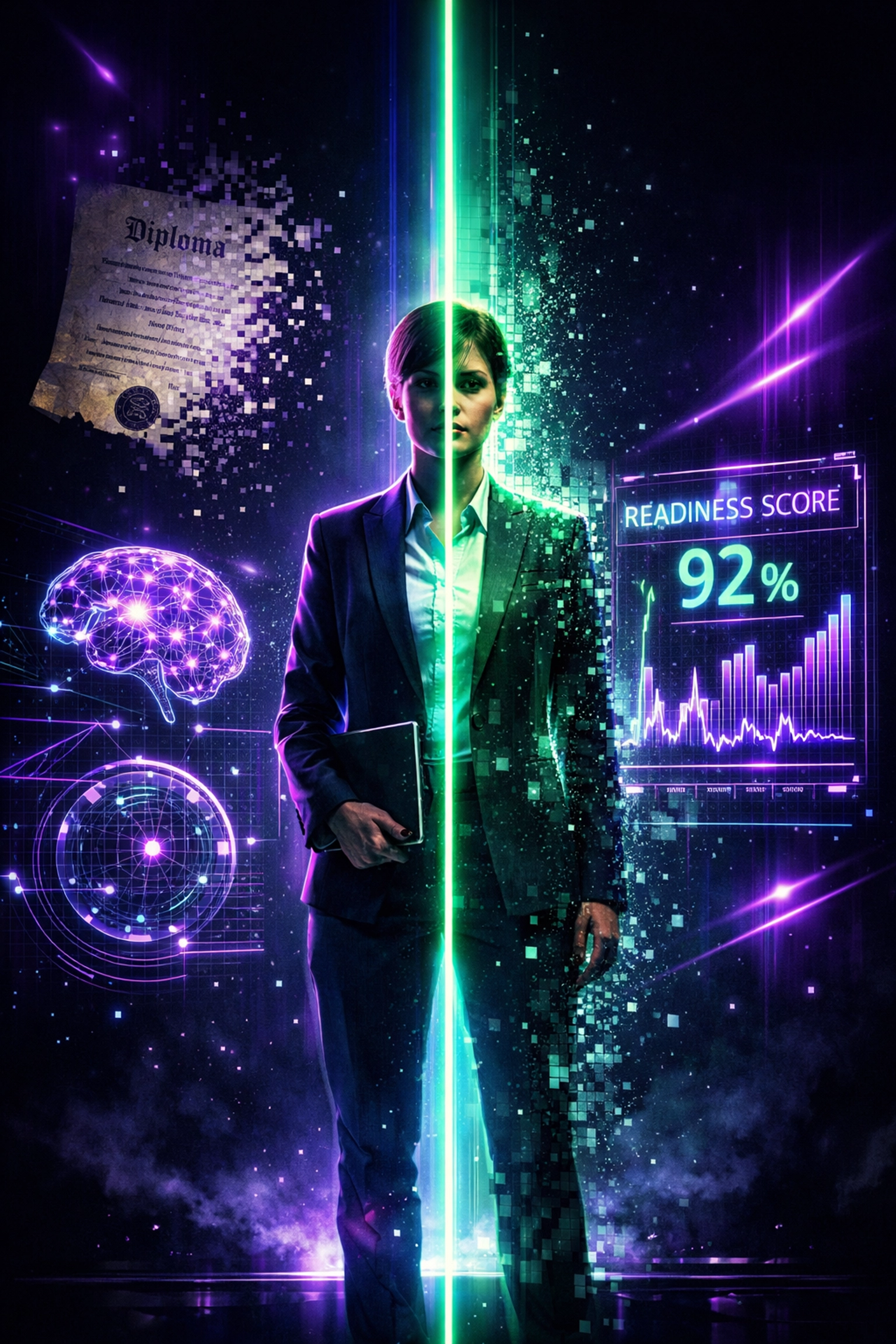
Career centers focus on the past: what classes you took. AI assessments focus on the future: what you can deliver on Day 1. If you think your Dean’s List status is going to save you, you’re in for a brutal wake-up call. The Readiness Score matters because your GPA won’t fix the gap.
Secret #1: Your "Authenticity" is Being Measured by NLP
Career centers tell you to "be yourself." AI tells the company exactly who that self is using nlp solutions (Natural Language Processing).
When you take an AI assessment, every word you type, every pause in your video response, and the complexity of your sentence structures are analyzed. Companies use custom ai solutions to build a linguistic profile of you. Are you a leader? A follower? Are you prone to burnout? Are you lying about your experience with Python?
The AI knows.
The secret career centers miss is that these assessments aren't looking for the "right" answer. They are looking for consistency. If your resume claims you’re a "highly motivated self-starter" but your assessment data shows a pattern of hesitation and low-complexity problem-solving, the system flags you as a mismatch.
Secret #2: The "Bot vs. Bot" Trap
Here is something your professors won't tell you: If you use ChatGPT to write your assessment responses, you’ve already lost.
Companies are now deploying intelligent automation solutions specifically designed to detect AI-generated content. If you copy-paste a generic response into a text box, the assessment's internal nlp solutions will flag it in milliseconds.
The goal isn't to avoid AI; it's to use AI to augment your thinking, not replace it. Career centers are terrified of "cheating," so they tell you to avoid AI entirely. This is terrible advice. You should be using AI to research the company’s pain points, but your assessment answers must be your own voice. If you sound like a bot, the bot will reject you. It’s that simple.
Secret #3: Bias is Real, But Not Where You Think
The research is clear: AI assessments can inherit the biases of their creators. Career centers often use this as a reason to be "apprehensive" about the technology. But here’s the reality they won't admit: Humans are more biased.
An AI might have a data bias, but a human recruiter has "I don't like the school you went to" bias, "I don't like your accent" bias, and "I’m hungry and tired" bias.
The secret is that custom ai solutions are actually being used by top-tier firms to remove traditional bias. They don't care about your last name or your zip code. They care about your logic. If you know how to navigate the assessment, you can bypass the "old boys' club" of traditional networking.
However, you must be aware that there are mistakes you’re likely making with AI assessments that make you look less competent than you are.
How to Win: The 5-Step Strategy to Mastering the Assessment
You can’t hide from the algorithm, so you might as well master it. While your career center is teaching you how to format a margin, you should be doing this:
Audit Your Digital Presence: Before you even hit "Start" on an assessment, realize that ai automation tools are already scraping your LinkedIn and GitHub. If your assessment performance doesn't match your digital footprint, you’re out.
Focus on the "Readiness Score": Understand that companies want to see how you handle ambiguity. Don't just give the safe answer; give the answer that shows you understand the business impact.
Learn the Language of Automation: You don't need to be a coder, but you need to understand how intelligent automation solutions work. If you can explain how you would use AI to streamline a manual workflow, your Readiness Score will skyrocket.
Practice "Guided Authenticity": Use AI to prep, but ensure your final output is personalized. Mirror the company’s tone, but use your own specific experiences.
Stop Guessing: Most students fail because they don't know what they're being tested on. Read the guide on how to master AI assessments to understand the logic behind the screen.
Why Companies Love This (And Why You Should Too)
From a B2B perspective, this is a revolution. At LoudMindAI, we see it every day. Businesses are tired of hiring graduates who need six months of hand-holding before they produce a single dollar of ROI.
By implementing custom ai solutions and nlp solutions in the hiring process, companies can filter out the noise and find the 1% of students who are actually ready to work. It’s a win for them because it cuts down on "bad hire" costs, and it’s a win for you: if you’re part of that 1%.
If you’re a student who actually has skills, the AI assessment is your best friend. It levels the playing field. It doesn't matter if you didn't go to an Ivy League school; if your data proves you can do the job, the ai automation will put your profile at the top of the pile.

The Brutal Truth
Your career center is a safety net that has been shredded by the rapid advancement of technology. They are teaching you to survive in a world that no longer exists.
The companies you want to work for: the ones paying the big salaries and doing the cool work: are already using AI to decide your fate. They aren't looking for a "good student." They are looking for an "industry-ready professional" who understands how to thrive in an automated world.
The gap is closing, but only for those who know how to jump. Don't let a "Readiness Score" catch you off guard. Stop listening to the outdated advice and start learning how to speak the language of the algorithms that are now running the world.
Are you ready to be assessed? Or are you just ready to graduate? There is a massive difference. One gets you a piece of paper; the other gets you a career. Choose wisely.
Comments