Are Traditional Campus Placements Dead? Why 85% of "Job-Ready" Graduates Fail Real-World AI Assessments
- Monish Kumar

- Feb 23
- 5 min read
Your campus placement cell just declared another "successful season." Students walked across the stage with offer letters. Everyone celebrated. The college posted glowing numbers on LinkedIn.
Here's what they didn't tell you: 85% of those "job-ready" graduates will fail real-world AI assessments within their first 90 days on the job.
Not because they're incompetent. Not because they didn't study hard enough. But because the entire campus placement ecosystem has been operating on autopilot while the corporate world rewrote the rules.
The Brutal Truth: Campus Placements Aren't Dead: They're Just Irrelevant
Let's clear something up first. Campus hiring surged 24% in 2025. Recruiters are still showing up. Companies are still making offers. The placement "machine" is alive and well.
But here's the problem: it's a machine built for a world that doesn't exist anymore.
Traditional campus placements measure one thing exceptionally well: how good you are at traditional campus placements. They test your ability to memorize data structures, regurgitate theoretical frameworks, and nail the classic "tell me about yourself" opener.
What they don't measure? Whether you can actually do the job.

Enter AI assessments. Real-world, adaptive, scenario-based evaluations that expose the gap between "I passed my exams" and "I can solve actual business problems." And the results? Devastating.
When companies deploy intelligent automation solutions and AI-powered hiring platforms: which 66% of recruiters now use: they discover something alarming: the credentials don't match the capability. The GPA doesn't predict performance. The interview prep doesn't translate to execution.
Why Your "Job-Ready" Label Is a Lie
You spent four years in college. You attended lectures, completed projects, passed exams, and built a resume that looks impressive on paper. Your placement cell ran mock interviews. You got an offer.
Congratulations: you're officially job-ready.
Except you're not. Here's why:
The Skill Gap Crisis: 66% of recruiters cite skill gaps as their primary campus recruitment challenge. Not "lack of degrees." Not "insufficient applicants." Skill gaps. Your college taught you theory. The market demands execution.
The Preparation Gap: Most placement cells activate in your final year: exactly when it's too late. Students who begin continuous skill development from Year 1 see 40-50% better outcomes than those who cram placement prep into Semester 7. You're not behind because you're lazy. You're behind because the system waited until the last possible moment to care about your readiness.
The Communication Catastrophe: 73% of employers prioritize communication skills over technical knowledge. Yet how much time did your curriculum spend on persuasive writing, stakeholder management, or translating technical jargon into business value? You can code: but can you explain why it matters?
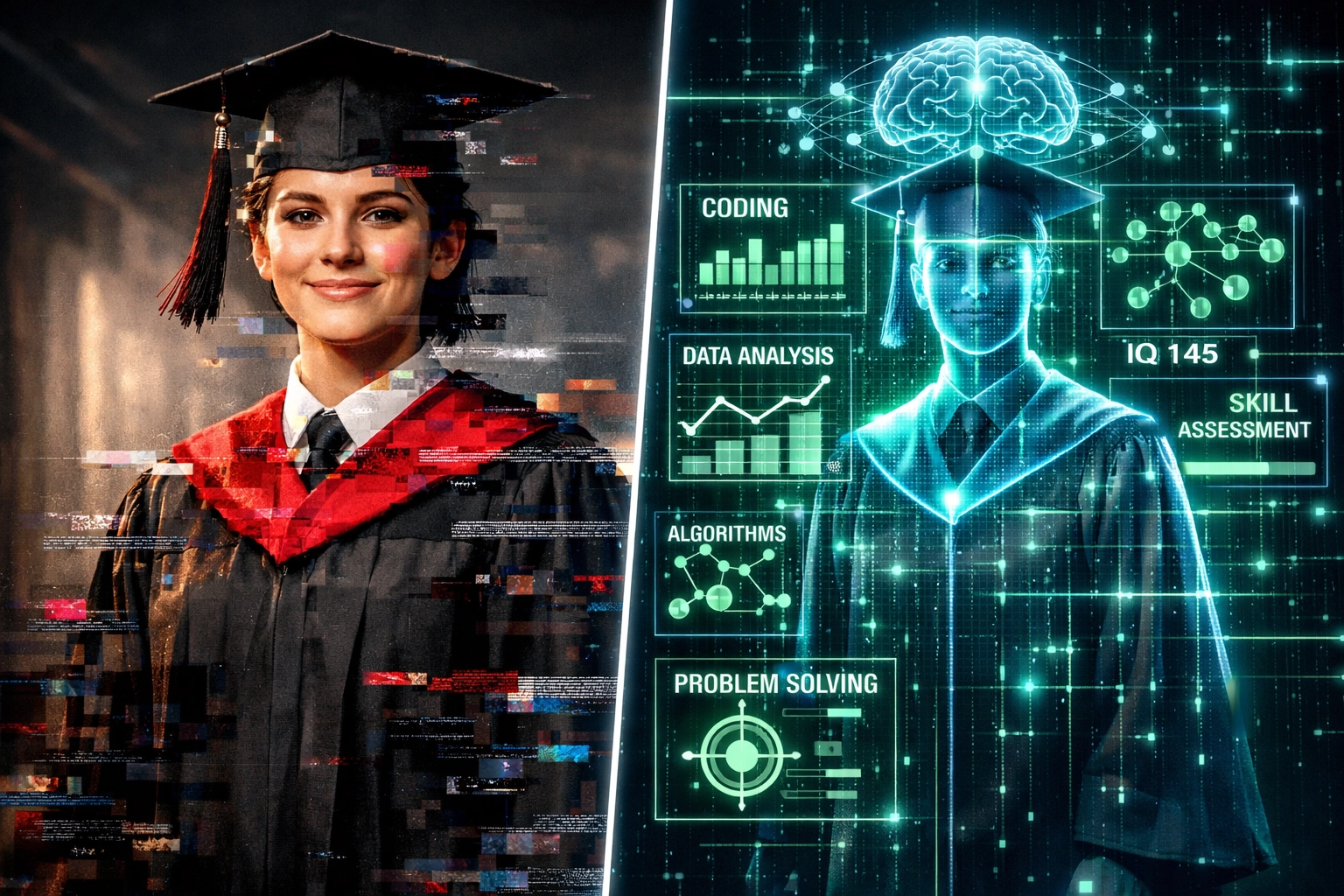
The AI Assessment Blind Spot: Here's the killer. Companies now use custom AI solutions that analyze everything from your problem-solving approach to your communication patterns to your ability to handle ambiguity. These aren't your college's multiple-choice tests. These are adaptive, dynamic assessments designed to simulate real work scenarios.
And you've never practiced for them. Because your placement cell is still running the same interview drills they ran in 2015.
What Happens When AI Meets "Job-Ready" Graduates
Let's talk about what these AI assessments actually reveal.
Modern hiring platforms: powered by NLP solutions and machine learning algorithms: don't just evaluate your answers. They evaluate how you arrive at answers. Your thought process. Your adaptability when the problem shifts mid-assessment. Your ability to communicate complex ideas clearly.
Traditional placement prep doesn't prepare you for this. At all.
Students who ace conventional interviews often freeze when faced with AI-powered scenario assessments. Why? Because they've been trained to perform, not to think. To memorize patterns, not to solve novel problems. To present a polished version of themselves, not to demonstrate authentic capability.
The result? An 85% failure rate on assessments that actually matter.
The Real Problem: Campus Placements Optimize for the Wrong Metric
Your college measures success by placement percentage. How many students got offers? What was the average package? Which brand-name companies showed up?
None of those metrics measure what happens after you join.
Companies, meanwhile, are drowning in regret hires. They're spending an average of ₹50,000 per candidate: between recruitment costs, training investments, and productivity losses: only to discover that "job-ready" graduates need months of remedial training before they contribute value.

This isn't sustainable. Which is why forward-thinking organizations are bypassing traditional placement channels entirely and building their own assessment frameworks using AI automation platforms.
These companies aren't looking for students who can pass exams. They're looking for candidates who can:
Analyze messy, real-world data and extract actionable insights
Communicate findings to non-technical stakeholders
Adapt when requirements change mid-project
Collaborate across functions and time zones
Learn continuously as technology evolves
Your campus placement didn't test any of that.
The Solution Isn't More Mock Interviews: It's AI-Powered Readiness
Here's the good news: this gap is solvable. But not with the same tired tactics.
Students who train specifically for AI assessments see 3x higher success rates compared to those who stick with traditional prep. Not because they're smarter. Because they're practicing the right skills.
This means:
Continuous Skill Development: Starting from Year 1, not Semester 7. Building a portfolio of real-world projects, not exam scores. Demonstrating applied knowledge, not theoretical mastery.
AI Assessment Exposure: Practicing with the same tools recruiters actually use. Getting comfortable with adaptive, scenario-based evaluations. Learning to think under pressure, not just perform rehearsed answers.
Competency Mapping: Understanding exactly where you stand on industry-relevant skills. Not generic GPAs. Not vague "proficiency levels." Concrete, measurable readiness scores that predict job performance.
Platforms like Industry Ready are solving this by giving students access to AI-powered assessments that mirror real hiring scenarios. You get immediate feedback. You identify gaps. You close them systematically.
This isn't about gaming the system. It's about building actual capability.
What Colleges and Companies Need to Do Right Now
For educational institutions: stop celebrating placement percentages and start tracking post-hire performance. Partner with platforms that provide continuous competency assessment. Build curricula around skills that AI can't easily replicate: creative problem-solving, ethical reasoning, cross-functional communication.
For companies: stop wasting recruitment budgets on candidates who look good on paper but can't execute. Implement AI-driven assessment frameworks that evaluate real-world capability. Use intelligent automation solutions to identify genuine talent, not polished performers.
For students: recognize that getting placed isn't the finish line: it's the starting gun. Invest in platforms that expose your readiness gaps early. Practice with AI assessments before they determine your career trajectory. Build provable skills, not impressive-sounding bullet points.
The Campus-to-Career Gap Is Widening: Unless You Act
Traditional campus placements aren't dead. They're just obsolete for measuring what actually matters.
The companies winning the talent war have moved beyond resumes and conventional interviews. They're using custom AI solutions to identify candidates who can deliver value from day one. They're deploying autonomous assessment agents that evaluate competency, not credentials.
If you're still operating in the old paradigm: building resumes, rehearsing generic answers, treating placement as a one-time event: you're preparing for a job market that no longer exists.
The students who thrive won't be the ones with the highest GPAs. They'll be the ones who invested in AI-powered readiness platforms, built measurable skills, and proved their capability through real-world assessments.
The choice is yours: keep playing by outdated rules and become part of the 85% who fail real-world evaluations, or adapt to the new reality and join the 15% who actually succeed.
Your placement cell won't tell you this. But your future employer will: on your first performance review.
Learn how AI assessments can bridge your campus-to-career gap or discover how LoudMindAI's intelligent automation solutions are transforming talent readiness across industries.
Comments