Stop Sending Students Into the Void: 7 AI Assessment Secrets That Actually Close the Campus-to-Career Gap
- Monish Kumar

- Feb 10
- 5 min read
Here's the brutal truth: Your institution is graduating students with perfect GPAs who can't survive their first 90 days in the workplace.
Not because they're not smart. Not because they didn't study hard enough. But because traditional assessments measure the wrong things entirely.
You're testing memorization when employers need problem-solving. You're grading essays when the market demands execution. You're issuing diplomas when companies are screaming for proof of actual capability.
The campus-to-career gap isn't a gap: it's a chasm. And most educational institutions are standing on the wrong side, wondering why their graduates keep falling in.
AI assessments aren't just another EdTech trend. They're the bridge that actually gets students across. Here are the seven secrets that make the difference.
Secret #1: Real-Time Feedback Loops Beat End-of-Semester Post-Mortems
Remember when you handed back graded papers three weeks after submission? When students received feedback on projects they'd already mentally moved past?
That model is dead.
AI-powered assessment delivers immediate, tailored feedback at the exact moment students need it most. Not days later. Not weeks later. Right now: when the learning opportunity is hot and the context is fresh.

Why does this matter for career readiness? Because the workplace doesn't wait three weeks to tell you your presentation flopped or your code broke production. Real-world feedback is instant, iterative, and relentless.
Custom AI solutions can analyze student work across multiple dimensions simultaneously:
Technical accuracy and completeness
Communication clarity and professional tone
Problem-solving approach and methodology
Time management and deadline adherence
Collaboration patterns and peer interaction quality
Students adapt their strategies in real-time. They course-correct immediately. They develop the feedback-responsive mindset that separates thriving professionals from struggling graduates.
Secret #2: Skills Mapping Destroys the GPA Illusion
Your 4.0 student might be brilliant at theoretical frameworks and terrible at stakeholder communication. Your 3.2 student might be a workflow optimization genius who struggles with standardized tests.
Traditional grading flattens everything into a single number that tells employers almost nothing useful.
Intelligent automation solutions for assessment create granular skills maps: multidimensional profiles that show exactly what a student can actually do. Not what they've memorized. Not what their aggregate score suggests. What specific, employer-valued competencies they've demonstrated.
Think of it as a Readiness Score on steroids:
Technical skills broken down by specific tools and methodologies
Soft skills measured through real interaction patterns
Industry-specific competencies benchmarked against market standards
Learning velocity indicators showing adaptation capability
Collaboration and leadership signals from group work analysis
Employers don't need another GPA. They need a searchable, verifiable skills inventory that maps directly to job requirements.
Secret #3: AI-Powered Simulations Replace "What Would You Do?" Questions
Hypothetical scenarios are worthless. "Tell me about a time when..." interviews are performance theater. Traditional case studies are academic exercises divorced from messy reality.
AI assessments drop students into realistic simulations where choices have consequences, incomplete information forces judgment calls, and time pressure mirrors actual workplace chaos.
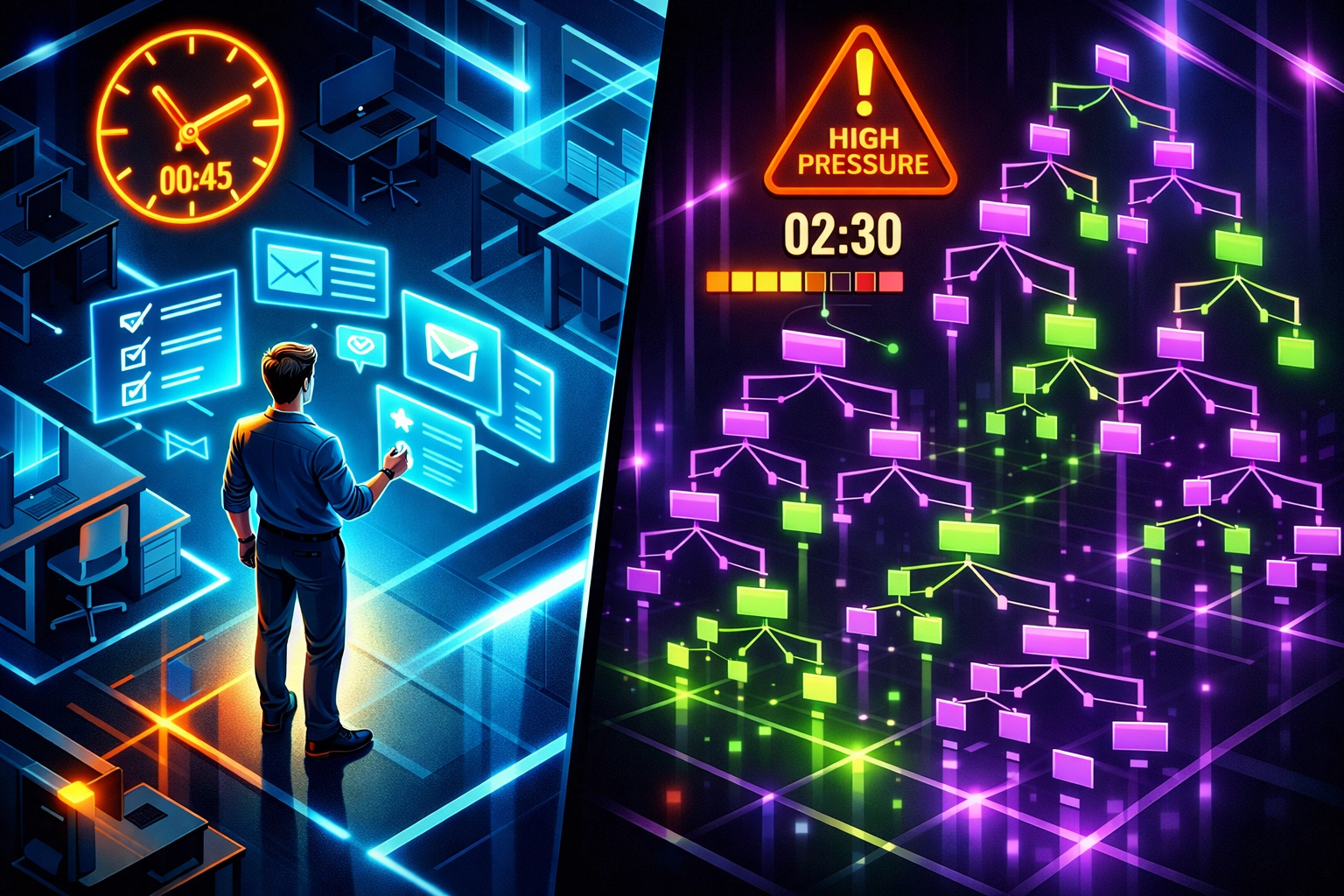
Want to test project management skills? Simulate a product launch with budget constraints, timeline slippage, stakeholder conflicts, and technical surprises. Track every decision. Analyze the outcomes. See how students actually perform under pressure: not how well they can talk about hypothetical situations.
NLP solutions can evaluate:
Decision quality under ambiguity
Communication effectiveness across stakeholder types
Resource allocation priorities
Risk assessment and mitigation approaches
Crisis response patterns
This is ai automation applied to career preparation: letting students fail safely in simulated environments so they don't fail catastrophically in real ones.
Secret #4: Critical Thinking Through AI Interaction (Not Despite It)
Here's where most institutions get it backwards. They ban AI tools from assessments because they're afraid students will "cheat."
Newsflash: Every professional job your graduates will enter already uses AI tools extensively. Banning AI from assessments is like banning calculators from engineering programs or spell-check from writing courses.
The secret isn't preventing AI use: it's designing assessments that require students to think critically about AI outputs.
Give students AI-generated analysis and ask them to identify flaws, biases, and gaps. Provide AI-created proposals and require them to improve, challenge, or synthesize alternatives. Present AI recommendations and demand students justify agreement or articulate superior approaches.
This develops the meta-cognitive skills that define career success in an AI-augmented workplace:
Evaluating source credibility and output quality
Identifying limitations and blind spots
Combining human judgment with machine capability
Knowing when to trust automation and when to override it
Your graduates will work alongside AI systems. Assessment should prepare them for that reality: not pretend it doesn't exist.
Secret #5: Portfolio Assessment Beats Multiple Choice Every Time
Multiple choice questions measure recognition. Employers need demonstration.
Custom AI solutions can evaluate student portfolios at scale: something that was previously impossible without massive faculty time investment. AI can assess:
Portfolio completeness and professional presentation
Work quality across multiple project types
Progress trajectory and skill development over time
Authentic voice versus template usage
Industry standard alignment

But here's the key: AI assessment doesn't replace human evaluation: it augments it. Intelligent automation handles initial screening, pattern recognition, and quantitative analysis. Faculty focus on nuanced judgment, contextual interpretation, and strategic guidance.
Students build portfolios that become their career launchpads. Not because they completed assignments, but because they created demonstrable proof of capability that speaks directly to employer needs.
Secret #6: Continuous Readiness Scoring Replaces One-Time Career Tests
Career readiness isn't binary. It's not something students either have or don't have on graduation day.
It's a continuously evolving metric that shifts as students develop skills, complete projects, engage with industry, and demonstrate growth.
Traditional assessments take snapshots. AI assessment creates motion pictures: tracking readiness evolution across entire educational journeys. Your Readiness Score isn't a final grade. It's a living indicator that updates as students progress.
This matters because employers care about trajectory as much as current state. A student with a 65% readiness score who's climbed from 40% in six months shows more promise than someone stuck at 70% for two years.
Continuous assessment powered by ai automation enables:
Early intervention when students fall behind
Personalized learning pathways based on gap analysis
Real-time alignment between curriculum and market demands
Predictive analytics for career placement success
Evidence-based program improvement decisions
Secret #7: Industry-Aligned Benchmarking Obliterates Academic Standards
Academic standards are internally referenced. They measure students against other students, against historical cohorts, against curriculum objectives.
Industry-aligned benchmarking measures students against actual job requirements.
This is where intelligent automation solutions become transformational. AI systems can:
Analyze thousands of job postings to extract real-time skill requirements
Benchmark student capabilities against industry expectations
Identify emerging competency demands before they become mainstream
Map educational outcomes to specific career pathways
Provide employers with validated, trustworthy readiness signals
You're not preparing students for your curriculum anymore. You're preparing them for markets that are evolving faster than any curriculum committee can track.
NLP solutions scan job descriptions, company requirements, and industry reports continuously: feeding that intelligence back into assessment design and readiness evaluation.
Students graduate knowing exactly how they measure up against current market demands. Not how they compare to last year's cohort.
The Bridge, Not the Barrier
Stop treating assessment as a gatekeeping mechanism. Start seeing it as the bridge between academic learning and professional capability.
AI assessment isn't about replacing educators: it's about eliminating the blind spots that send students into careers unprepared. It's about giving students the feedback, skills mapping, realistic practice, and industry benchmarking they actually need to succeed.
The campus-to-career gap exists because we've been measuring the wrong things in the wrong ways at the wrong times. These seven secrets don't just improve assessment: they fundamentally reshape what "career ready" actually means.
Your next graduating class deserves better than a diploma and a prayer. They deserve a validated, comprehensive, industry-aligned readiness profile that opens doors instead of leaving them knocking.
Ready to transform how your institution prepares students for career success? Let's build assessment systems that actually bridge the gap.
Comments