Stop Sending Generic Resumes: 5 AI Assessment Secrets That Bridge the Campus-to-Career Gap in 30 Days
- Monish Kumar

- Feb 1
- 6 min read
Your resume just landed in a digital graveyard. Again.
Three hundred applications. Twelve automated rejections. Zero interviews. You've got a degree, decent grades, maybe even an internship: but you're shouting into a void that doesn't care about your GPA or that group project you led.
Here's the brutal truth: The campus-to-career gap isn't about what you know. It's about proving what you can do: and generic resumes prove nothing.
But what if I told you there's a 30-day blueprint that flips the script entirely? Not another "optimize your LinkedIn" article. Not another resume template. We're talking about AI-powered assessment systems that expose exactly what employers want and show you how to demonstrate it before you even click "Apply."
Welcome to the age of intelligent automation solutions: where your job search becomes a data-driven operation, not a hope-and-pray strategy.

The Resume Black Hole: Why 98% of Graduates Are Playing a Losing Game
Let's call it what it is: You're being filtered out by algorithms before a human ever sees your name.
Applicant Tracking Systems (ATS) scan for keywords. Recruiters spend 6 seconds per resume. Entry-level roles receive 250+ applications. Your carefully crafted bullet points? They're competing against hundreds of identical "responsible for" and "assisted with" statements.
Generic resumes die in the digital noise. They lack specificity. They lack proof. They lack the one thing that matters in 2026: a quantifiable readiness score that tells employers you're not just qualified on paper, you're operationally ready on day one.
This is where AI assessments change everything. Not the kind that ranks your resume layout. The kind that evaluates your actual capabilities against real industry benchmarks and gives you actionable intelligence to close the gaps: fast.
Secret #1: Skill-Mapping With NLP: Know What Recruiters Actually Search For
Stop guessing which skills matter. Start knowing.
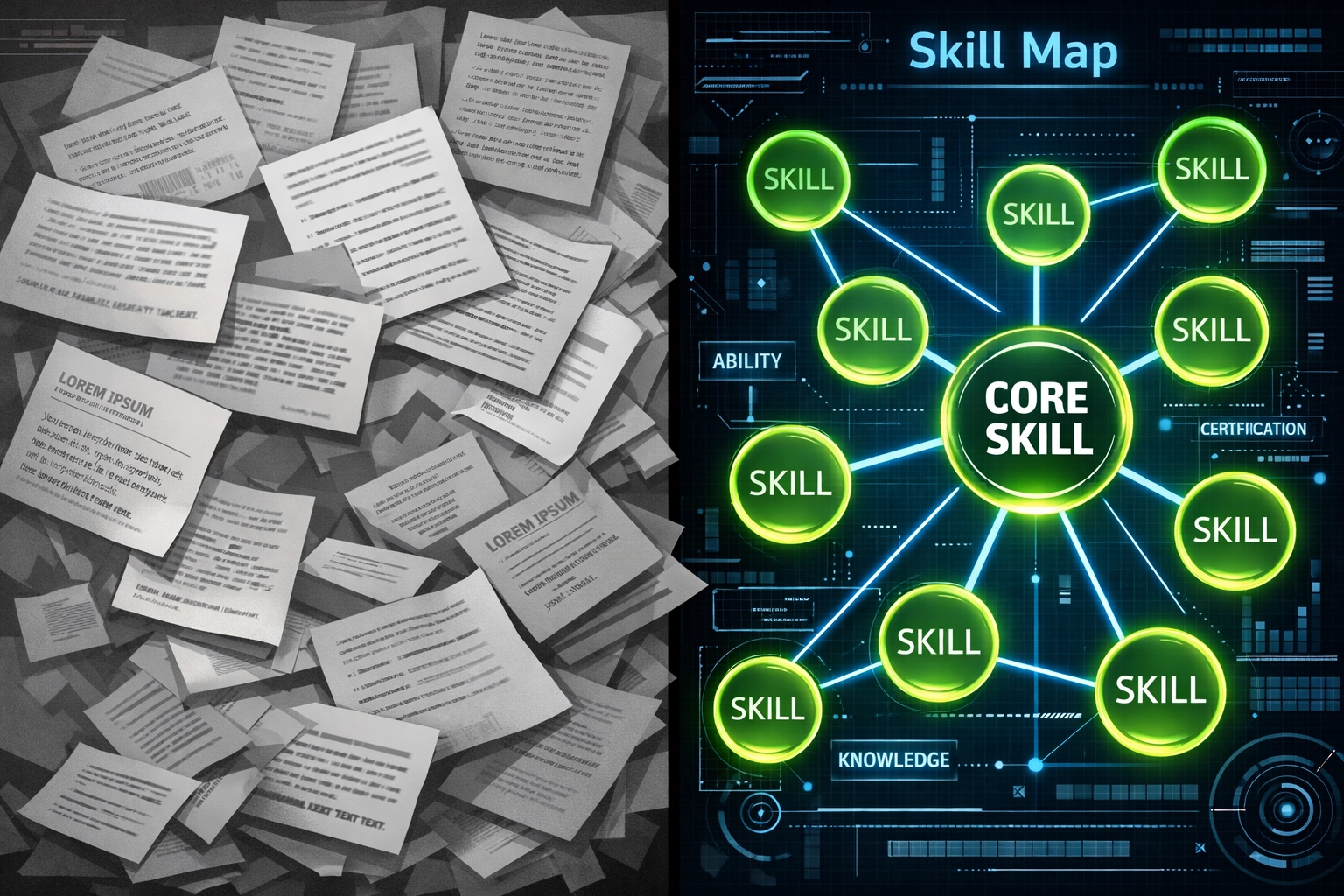
Advanced NLP solutions can analyze thousands of job postings in your target field and extract the most in-demand competencies: not just buzzwords like "teamwork," but technical frameworks, software tools, and domain-specific methodologies that separate candidates who get callbacks from those who get ghosted.
Here's what this looks like in practice:
Input: Your target role (e.g., "Marketing Analyst," "Junior Data Scientist")
Process: AI scrapes and analyzes 500+ active listings using natural language processing
Output: A prioritized skill map showing what's required vs. nice-to-have vs. completely irrelevant
You discover that "SQL" appears in 87% of data analyst postings. That "Google Analytics 4" is rapidly replacing "Universal Analytics." That employers don't care about your Adobe Illustrator skills for this particular role: they want Tableau.
Suddenly, you're not padding your resume with generic "proficient in Microsoft Office." You're targeting the exact stack that gets past the ATS gatekeepers. That's intelligent automation working for you, not against you.
Secret #2: Real-Time Competency Benchmarking: Get Your Industry Readiness Score
Generic resumes hide weaknesses. AI assessments expose them: and that's actually your advantage.
Imagine submitting your current resume, portfolio, and skillset to a platform that benchmarks you against actual industry standards for entry-level performance. Not what universities think matters. Not what career counselors guess. What companies hiring right now demand.
You receive a Readiness Score: let's say 64/100: broken down by category:
Technical Skills: 72/100
Communication: 58/100
Problem-Solving: 69/100
Domain Knowledge: 61/100
Here's the game-changer: Each gap comes with a specific action plan. Not "improve communication skills" (useless). But "Complete this 6-hour business writing course" or "Build a portfolio project demonstrating X framework" (actionable).
This is the campus-to-career gap being quantified and closed systematically. In 30 days, you can transform a 64 into an 82: and suddenly you're not competing with hundreds of applicants. You're in the top 15%.
Secret #3: Job Description Deconstruction: Auto-Match Your Profile to Every Application
Stop sending the same resume everywhere. That's career suicide in 2026.
AI assessment tools powered by custom AI solutions can analyze any job description you paste in and immediately tell you:
Match Percentage: How closely your current profile aligns (e.g., 43% match)
Missing Keywords: Technical terms and skills you need to incorporate
Experience Gaps: Where the listing wants "2 years" but you have "1 internship"
Priority Adjustments: Which bullet points to emphasize and which to remove
This isn't resume-spinning. This is strategic positioning.
You're not lying about your experience: you're reframing how you describe it to speak the employer's language. That group project? It becomes "cross-functional collaboration delivering X outcome." That internship task? It becomes "automated reporting workflows using Y tool, reducing manual effort by Z hours."
The AI doesn't write it for you: it shows you where to pivot your framing so you're highlighting what matters instead of what doesn't.

Secret #4: Simulated Job Scenarios: Prove Competency Before the Interview
Here's where it gets loud: Stop telling employers you can do the job. Show them.
The most advanced AI assessment platforms now include simulated work scenarios that test your actual ability to perform role-specific tasks:
Marketing roles: Analyze a sample campaign dataset and present actionable insights
Developer roles: Debug a code snippet or build a feature based on requirements
Sales roles: Respond to simulated customer objections using best practices
Your performance gets scored. Not by gut feel: by comparing your output against benchmarks from successful professionals in that role.
You can include these results in your application materials: "Scored 88/100 on [Assessment Platform]'s Junior Analyst simulation: top 12% of test-takers."
Suddenly, you're not a generic resume. You're a pre-validated candidate with third-party proof of capability. Recruiters love this because it de-risks their hiring decision. You love this because it circumvents the "experience required" trap.
This is AI automation eliminating the biggest barrier to entry: the assumption that fresh graduates can't contribute immediately.
Secret #5: Feedback Loops That Accelerate Learning: Turn Rejections Into Data
Most job seekers treat rejections as emotional gut-punches. You need to start treating them as data points in an optimization process.
AI-powered tracking systems can help you log every application, note which variations you used, and correlate outcomes with specific changes:
Applications using "Version A" resume: 3% response rate
Applications using "Version B" resume (post-AI assessment revision): 11% response rate
Applications to companies in [specific sector]: 18% response rate
You start identifying patterns. Maybe your technical skills aren't the problem: it's how you're describing your internship experience. Maybe you're applying to the wrong company sizes. Maybe you need one more certification to cross a threshold.
This feedback loop: powered by intelligent automation: transforms your job search from a black box into a transparent system you can actually improve. Every week, you're iterating. Every iteration, you're closing the gap.
In 30 days, you're not the same candidate who started. You're measurably better, strategically positioned, and data-informed.

The 30-Day Bridge: From Generic to Irreplaceable
Here's what this actually looks like as a timeline:
Week 1: Run the NLP skill-mapping analysis. Identify your 5 biggest gaps versus market demand. Start filling the most critical one (online course, tutorial, practice project).
Week 2: Complete an AI-driven competency assessment. Get your Readiness Score. Build a targeted action plan to improve your bottom two categories.
Week 3: Apply the job description auto-matching tool to 10 target roles. Revise your resume and portfolio to emphasize relevant experience. Complete at least one simulated scenario assessment.
Week 4: Launch applications with your revised, data-backed profile. Include your assessment scores where relevant. Set up tracking for feedback loops. Iterate based on initial responses.
This isn't about becoming a different person. It's about eliminating the noise and amplifying the signal: showing employers exactly what they're looking for in a format they can't ignore.
Why This Matters More Than Your Degree
Universities teach theory. Employers hire execution.
The campus-to-career gap exists because academic credentials don't translate cleanly into workplace readiness. Your transcript says you passed Econ 301. It doesn't say you can build a financial model under deadline pressure. Your degree says you can write essays. It doesn't prove you can craft client-facing presentations.
AI assessments and readiness scoring systems bridge this gap by creating a universal language between what students have and what companies need. They replace vague claims with quantified proof.
And here's the best part: Once you understand this system, you're not just using it to land your first job. You're using it to accelerate every career transition from here forward. This is the playbook for 2026 and beyond.
Stop Competing: Start Converting
You have two choices.
Keep sending generic resumes into the void. Keep wondering why companies ghost you despite your qualifications. Keep playing a game where 98% of applicants lose.
Or leverage custom AI solutions and NLP-powered assessments to decode exactly what employers want, prove you can deliver it, and position yourself in the top tier before the interview even starts.
The campus-to-career gap is brutal: but only if you're fighting it with outdated tools.
Ready to build a smarter job search strategy? Explore how LoudMindAI's intelligent automation solutions can help you move from generic to irreplaceable: whether you're a student looking to prove readiness or an organization looking to identify it.
The 30-day clock starts now.
Comments